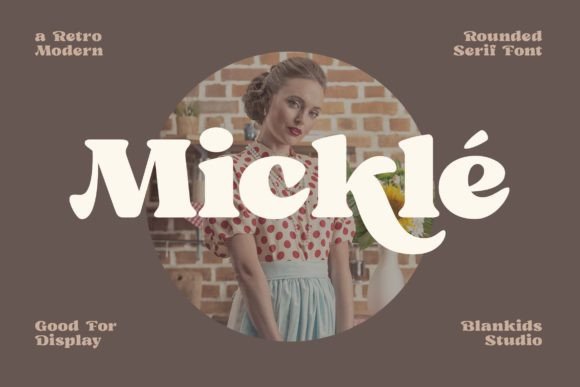
Mickle Serif Font: Retro-Elegant Charm for Handmade Brands
As a maker who prints labels, cuts vinyl stickers, designs wedding invites, and crafts seasonal SVG bundles, I know how much a single font can shift the entire feel—and sales—of a product. That’s why Mickle stopped me mid-design session. It’s not just another serif font—it’s a quiet confidence-builder in type form. With its rounded serifs and clean, uncluttered lines, Mickle balances vintage warmth and modern clarity in a way that feels intentional, not trendy.
Mickle works where so many serifs stumble: on small physical items. Think ¾-inch candle labels, 2-inch boutique tags, or die-cut sticker sheets for planners. Its generous x-height and open counters mean it stays legible even at 10pt on a printed hang tag—or when scaled down for Cricut or Silhouette cut files. Unlike high-contrast serifs that thin out unpredictably on vinyl or kraft paper, Mickle’s consistent stroke weight holds up beautifully in both digital mockups and real-world production.
I’ve used Mickle across six different product categories this season—and each time, customers commented on the “thoughtful” or “elegant but approachable” vibe. For handmade soap labels, I paired Mickle’s bold weight with a soft handwritten script for ingredients—creating hierarchy without visual noise. On farmhouse-style wall art prints (“Gather,” “Bloom,” “Home”), Mickle alone carried the message with grounded grace. And for holiday packaging—think linen gift boxes with gold foil stamping—I used Mickle’s light italic for delicate secondary text, letting the main title shine in the regular weight.
It shines brightest as a display font, especially for short, impactful phrases: shop names, product names (like “Hearth & Honey Vanilla Bean”), wedding monograms, or welcome signs. But don’t assume it’s only for titles. The full family includes regular, italic, bold, and bold italic—so you can build subtle typographic rhythm into printable planner pages or digital downloads without switching fonts. I use the italic for gentle emphasis in recipe cards and the bold for section headers in editable Canva templates—no design fatigue, no inconsistency.
What makes Mickle truly practical for crafters? Its thoughtful details translate directly to production ease. The rounded serifs soften sharp corners—critical when cutting intricate letters from vinyl or cardstock. There are no overly delicate terminals or hairline strokes that vanish on low-res printouts or blur under matte laminate. And because it’s a well-hinted serif font, it renders crisply on screen previews—meaning your Etsy thumbnail, social media graphic, or PDF preview looks exactly like the final printed piece.
Font pairing is where Mickle becomes a team player. I regularly pair it with a relaxed script font (like a natural-looking brush script) for invitations or greeting cards—Mickle handles the structure while the script adds personality. For product packaging or boutique signage, I’ll combine Mickle’s bold weight with a clean, neutral sans serif (think a friendly geometric or humanist sans) for body text or legal disclaimers. This combo reads as premium but never pretentious—ideal for small-batch skincare, artisan coffee, or ceramic studios building brand identity through typography.
Real talk: Mickle isn’t built for long paragraphs. You won’t set a 50-page ebook in it—and you shouldn’t. But that’s not its job. Its strength lies in commercial clarity: making your shop name memorable, turning a simple “Thank You” sticker into a keepsake, or giving a wedding welcome board instant warmth and sophistication. When customers see Mickle on your mug wrap or tote bag design, they subconsciously register care, intention, and quality—because the font itself feels considered, not generic.
For digital product creators, Mickle delivers versatility across formats. It’s fully compatible with Cricut Design Space, Silhouette Studio, Adobe Illustrator, and Canva. The OTF and TTF files include standard ligatures and stylistic alternates—subtle touches like a swashed capital “Q” or connected “Th” that add polish to SVG-based quote art or printable wall decor. If you’re designing multilingual printables (especially for English, Spanish, French, or German markets), Mickle supports extended Latin characters—so your “Merci” or “Gracias” tags render cleanly, no missing glyphs.
Licensing matters—and Mickle comes with a clear, commercial-friendly license. You can use it to create and sell physical products (stickers, mugs, apparel), digital downloads (planner inserts, invitation suites, SVG cut files), client work (logo design, packaging layouts), and even templates for platforms like Creative Market or Etsy. No hidden restrictions. Just make sure you’re using the official version—not a free knockoff—so you get the full character set, kerning pairs, and technical reliability your business depends on.
Here’s what I keep coming back to: Mickle doesn’t shout. It invites. Whether it’s a minimalist black-and-white baby shower invite, a rustic bakery label with soy ink on recycled paper, or a gold-foiled holiday ornament tag, Mickle lends quiet authority without sacrificing charm. It’s the kind of premium font that makes your handmade brand feel cohesive—even if you’re juggling ten different product lines.
If you’re choosing fonts for your next batch of printable wall art, seasonal sticker pack, or custom packaging suite, ask yourself: Does it support my product’s story—not just look pretty in isolation? Mickle does. It’s elegant enough for weddings, grounded enough for farmhouse goods, and distinctive enough to stand out in a crowded Etsy search. And most importantly? It works as hard as you do—on screen, on paper, on vinyl, and in the hands of your customers.